I was working my way through a guest post (I'll link to it later in the week) tonight, remembering all the time a conversation that I'd had recently with Sister C:
C: "I read your guest post at [insert name of fabulous blog] today," she said. "It was good. But..."
Me: "But????" (There may have been a hint of defensive paranoia in the tone. Maybe.)
C: "Your guest posts never sound as 'you' as your blog posts do."
Me: "Hmmm." Ruminations. "I think it's because I'm writing in someone else's space. So it feels more like a column or an article. So I immediately switch to a more professional voice. A magaziney voice, I guess."
C: "Like a broadcast voice versus an intimate voice."
Exactly. When I write here, I feel as though I'm writing in a room. One part of me is aware (always aware) that it's a public room, but it feels like a live, unplugged gig. As soon as I step into another room, I'm more aware of the audience, so I step up a little, put on my stage face and plug into some electricity.
On someone else's blog, I feel like the support act, warming up for the show that everybody really wants to see (the blogger that they love), singing my heart out to a room full of people who are all talking amongst themselves and trying to time their toilet breaks so as not to miss the main act.
One of the first things I learned about blogging, via my endless, obsessive reading in the first few months, was about the importance of guest posting in helping to build a blog. It makes sense. A guest post introduces you and your style to a whole new audience. One that, hopefully, will like enough of what they see to follow you home. For that reason, I always say yes when I'm asked to guest post. If someone is kind enough to put me on their marquee (and offer M&Ms (red only) for my rider), I'm going to say yes, thanks for having me, and do my best to deliver them a show-stopping post.
But I won't say that I don't get stage fright about it.
How do you feel about guest posting? Do you love it or do it because you feel you should?
[image: button by BuyTheLightOfTheMoon/etsy}
Sunday, October 16, 2011
Thursday, October 13, 2011
A blog is a chain made of 1000 links (Happy SITS Day to me!)
Back in the early days, when I'd started this blog on a dare and was beginning to work out that blogging is not writing and that it pays to invite the neighbours in for barbecues, I found myself on a site called The SITS Girls. The basic message: the secret to success is support. I liked it. I visited a lot. I signed up to be the featured blogger, to experience the joy of a SITS Day. I got busy. I visited more sporadically. I got busier, what with the Twitter and the Facebook. I became someone who popped by occasionally.
And then I got an email last week to say that my number had come up. My SITS Day was imminent. So I did what any normal person would do under the circumstances - I panicked.
Fortunately, I come from a family of bloggers. I emailed Sister B and Sister C (we are The Alphabet Sisters, A, B and C, in that order) and wondered aloud if I should have a spruce up. A makeover. Would I be good enough for such VIP guests? They laughed (they do that a lot when I make such suggestions, any suggestion come to think of it...).
"Didn't you write a post about this?" said B. "You Do What You Do."
So here I am. If we haven't met before, I'm Allison. I'm a freelance writer, a mother and a Mrs. I have two boys, Mr7 and Mr4 (aka Woody and Buzz), and a husband named The Builder (well, not really, but he likes the mystery). We all moved from The Big Smoke to Fibrotown three years ago, and we love it. I write about writing, being a work at home mum and ... whimsy. Sometimes I just write.
My blog was recently described as a 'mum-and-manuscript' blog and I liked that so much I've decided to own it. Anybody want to join my niche?
[Image: This 'Birds of a Feather' wall decal from urbanwalls/etsy is what I think bloggers might look like in the wild...]
And then I got an email last week to say that my number had come up. My SITS Day was imminent. So I did what any normal person would do under the circumstances - I panicked.
Fortunately, I come from a family of bloggers. I emailed Sister B and Sister C (we are The Alphabet Sisters, A, B and C, in that order) and wondered aloud if I should have a spruce up. A makeover. Would I be good enough for such VIP guests? They laughed (they do that a lot when I make such suggestions, any suggestion come to think of it...).
"Didn't you write a post about this?" said B. "You Do What You Do."
So here I am. If we haven't met before, I'm Allison. I'm a freelance writer, a mother and a Mrs. I have two boys, Mr7 and Mr4 (aka Woody and Buzz), and a husband named The Builder (well, not really, but he likes the mystery). We all moved from The Big Smoke to Fibrotown three years ago, and we love it. I write about writing, being a work at home mum and ... whimsy. Sometimes I just write.
My blog was recently described as a 'mum-and-manuscript' blog and I liked that so much I've decided to own it. Anybody want to join my niche?
[Image: This 'Birds of a Feather' wall decal from urbanwalls/etsy is what I think bloggers might look like in the wild...]
Wednesday, October 12, 2011
My world-famous, award-winning blog post
Have you noticed that there's no such thing as an ordinary, run-of-the-mill, average-beyond-imagination pie anymore? Or even a Quite Nice one?
Every pie shop or bakery you drive past features 'world famous', 'legendary' or 'award-winning' pies. I know this because on our drive down the coast to our holiday destination, we drove past at least three of these signs.
We even ate an 'award-winning' pie in Pambula, NSW. It was a very nice pie. But it didn't come with a trophy or have a blue ribbon stuck to it, and I would be hard-pressed to pick it out of a pie line-up.
Just what makes a pie 'world famous' or even 'legendary'? Who decides such things? Is there a 'world famous' list? Does word-of-mouth make it so? Or does it come down to the fact that nobody stops for a Quite Nice pie anymore?
Is there a world famous pie near you? Or even a Quite Nice one?
[image: perhaps you'd prefer a Barbie-sized pie, like this one from VansdollTreasures/etsy]
Every pie shop or bakery you drive past features 'world famous', 'legendary' or 'award-winning' pies. I know this because on our drive down the coast to our holiday destination, we drove past at least three of these signs.
We even ate an 'award-winning' pie in Pambula, NSW. It was a very nice pie. But it didn't come with a trophy or have a blue ribbon stuck to it, and I would be hard-pressed to pick it out of a pie line-up.
Just what makes a pie 'world famous' or even 'legendary'? Who decides such things? Is there a 'world famous' list? Does word-of-mouth make it so? Or does it come down to the fact that nobody stops for a Quite Nice pie anymore?
Is there a world famous pie near you? Or even a Quite Nice one?
[image: perhaps you'd prefer a Barbie-sized pie, like this one from VansdollTreasures/etsy]
Tuesday, October 11, 2011
The best organising tip I ever received (and actually use)
The Builder suggested I add point 11 to yesterday's list of the top 10 things I learned on holidays. His suggestion: no matter how long or fabulous the holiday, the second day back at work is always hard. I agree, but told him that nobody does 11 point lists. They just look wrong. So I came up with another one, to make it a nice round dozen.
12. The length of the holiday will be in direct proportion to the time it takes one to unpack one's bags after one returns home. To whit: if you go on holidays for one week and return on Sunday, you can be pretty sure those bags will still be sitting there come the following Sunday. And they will always contain three times as many clothes as you ever actually wore on said holiday.
But, having come up with that one, I decided that I would take a stand this time. I would unpack those bags. Today. I would... I would... I just...
I needed help. So I turned to a book sent to me recently by one of my favourite contacts, Lissanne Oliver. I call on Lissanne when I need help with the organisation/decluttering/simplifying end of the feature story spectrum. She is, quite simply, great at it, and gives good quote. Win/win for me. The only downside to our conversations is that she's usually saying things like 'People need to realise they can't work surrounded by piles of paper, lip balms, paper clips, nail scissors, random cables, books that need reading, articles that need referencing...' right while I'm sitting at a desk surrounded by all of those things.
Lissanne's book Sorted! is an action-stations guide to being organised. It has everything you need to clear space in your home, right down to the time-frames required to fulfill each step she outlines. Admittedly, there is not a section devoted to Unpacking After Your Holiday but much of the focus is on clearing living spaces - and given that the unpacked bags were interrupting a) traffic flow and b) air flow, I was able to use Lissanne's editing, filing and storing techniques to get the job done. Okay, half done. The Misters are now able to find their socks and undies for the morning. Me, maybe not so much.
It's progress, though, and that's what counts. Oh, and the best tip Lissanne ever gave me for a story (as in one that I actually use all the time)? Open your mail over the bin. Dump the stuff you don't need. Keep the stuff you do. Guaranteed to reduce the amount of paper entering your house.
Lissanne Oliver is joining forces with two international productivity and organising experts for the Six Steps To Your Organised Life workshops in Sydney (October 22) and Melbourne (October 29). Full details here. You can find out more about Lissanne's book and her organising work here.
12. The length of the holiday will be in direct proportion to the time it takes one to unpack one's bags after one returns home. To whit: if you go on holidays for one week and return on Sunday, you can be pretty sure those bags will still be sitting there come the following Sunday. And they will always contain three times as many clothes as you ever actually wore on said holiday.
But, having come up with that one, I decided that I would take a stand this time. I would unpack those bags. Today. I would... I would... I just...
I needed help. So I turned to a book sent to me recently by one of my favourite contacts, Lissanne Oliver. I call on Lissanne when I need help with the organisation/decluttering/simplifying end of the feature story spectrum. She is, quite simply, great at it, and gives good quote. Win/win for me. The only downside to our conversations is that she's usually saying things like 'People need to realise they can't work surrounded by piles of paper, lip balms, paper clips, nail scissors, random cables, books that need reading, articles that need referencing...' right while I'm sitting at a desk surrounded by all of those things.
Lissanne's book Sorted! is an action-stations guide to being organised. It has everything you need to clear space in your home, right down to the time-frames required to fulfill each step she outlines. Admittedly, there is not a section devoted to Unpacking After Your Holiday but much of the focus is on clearing living spaces - and given that the unpacked bags were interrupting a) traffic flow and b) air flow, I was able to use Lissanne's editing, filing and storing techniques to get the job done. Okay, half done. The Misters are now able to find their socks and undies for the morning. Me, maybe not so much.
It's progress, though, and that's what counts. Oh, and the best tip Lissanne ever gave me for a story (as in one that I actually use all the time)? Open your mail over the bin. Dump the stuff you don't need. Keep the stuff you do. Guaranteed to reduce the amount of paper entering your house.
Lissanne Oliver is joining forces with two international productivity and organising experts for the Six Steps To Your Organised Life workshops in Sydney (October 22) and Melbourne (October 29). Full details here. You can find out more about Lissanne's book and her organising work here.
Monday, October 10, 2011
10 things I learned on my holiday
Over an intimate sushi lunch today, Mr7 and I were discussing his imminent return to school tomorrow. He is ambivalent about the whole prospect. I am somewhat more excited. We talked about what he might have to do this week. He has choir practice, environment club, library... But what about in actual class?
"I suppose we'll have to write a recount about what we did on our holidays," he said, staring into his soy sauce with an Eeyore-like expression.
"We had fun!" I said.
"We did," he agreed. "But it's not much fun writing about it."
I tend to agree. The joy of the holiday is in the actual having of the holiday. But given it's a slow blog night, I am going to lead the way with my own Holiday Recount. Ten things I learned on my holiday.
1. Holiday houses that are advertised as 'complete with everything' are never complete with sharp knives. There will be a knife. Which will be blunt. And you will cut your hand off attempting to slice onions with it.
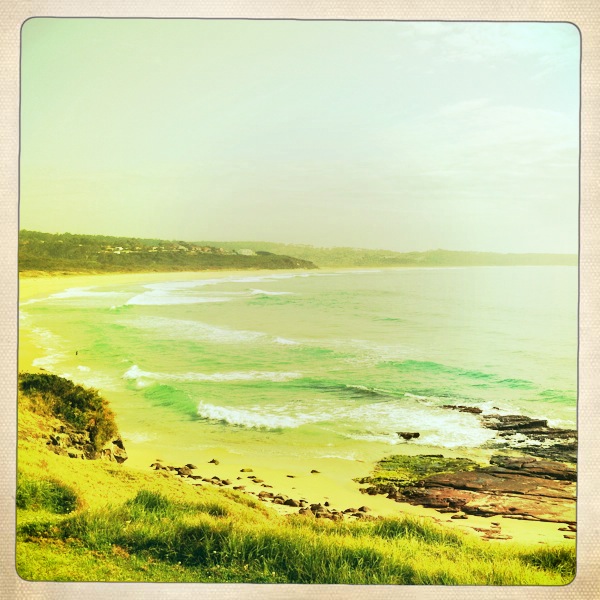
2. Holiday houses that show ocean views on their websites will have ocean views... filtered through a stand of trees. This is excellent for bird watchers. Of course, the house next door to yours will enjoy uninterrupted, panoramic views of rolling waves and endless sands (see image, shot from out the front of the house next door...).
3. Other People always seem better prepared for holidays than you are. No matter how prepared you are. They will arrive earlier, settle in better, have wetsuits for water slides when it's 17 degrees celsius, have boogie boards, skate boards, scooters, bicycles, surfboards, ski boards, the right shoes, the right board shorts, the right everything. You will forget the ball. The Jenga. The binoculars. The [insert everything else you remember once you're an hour from home].
4. Other People are prepared to queue for hours to go on a Toboggan slide. Bad parents like you will suggest an ice cream and a game of Putt Putt instead.
5. You will play Putt Putt golf. Even if you never, ever play Putt Putt golf, or consider it, at any other time, you will play Putt Putt golf on holidays. And it will be fun. Note: beware mentioning the words 'Whip your butt' to your spouse before realising that any Putt Putt skills you may once have had were left behind with your 10-year-old self.
6. You will sit through a children's movie. As the entire theatre squirms, and wriggles, and crunches, and crackles, and whispers, and giggles, and snorts, and wiggles in the darkness around you, you will strain your ears to catch the storyline to whichever Holiday Blockbuster has been dumped in theatres. It will be Smurftastic.
7. It takes longer to get there than to get home. Whether you are driving to your destination, or riding your bike behind a seven-year-old three-quarters of the way through a 10km bike ride. This may or may not be because it's downhill on the way home. If you are four, you will not care how far it is in either direction because you will sit in your car seat or coast on your Tagalong bike without a care in the world.
8. You will swim. It may be below freezing, it may be raining, it may be on the verge of snowing, but if you have small children and there is a pool, you will swim.
9. The sun always comes out as you're packing the car to go home. Murphy's Law. Even if it's rained all week (which, I hasten to add, it did not), the sun will blaze in all it's shiny, golden glory when it's time to go home.
10. You will have fun. So much fun. And come home relaxed, recharged and ready to slog through until the next holiday.
So that's my effort. I look forward to comparing it with Mr7's work tomorrow. I suspect his will focus on the $8 bow and arrow set that he bought from the local $2 shop on our holiday and which won his heart to the exclusion of all else. His teachers will note that Other People had better holidays.
What would you add to my list? Tell me what you know about family holidays.
[image: the almost view from our bungalow at Merimbula Beach Caravan Park]
"I suppose we'll have to write a recount about what we did on our holidays," he said, staring into his soy sauce with an Eeyore-like expression.
"We had fun!" I said.
"We did," he agreed. "But it's not much fun writing about it."
I tend to agree. The joy of the holiday is in the actual having of the holiday. But given it's a slow blog night, I am going to lead the way with my own Holiday Recount. Ten things I learned on my holiday.
1. Holiday houses that are advertised as 'complete with everything' are never complete with sharp knives. There will be a knife. Which will be blunt. And you will cut your hand off attempting to slice onions with it.
2. Holiday houses that show ocean views on their websites will have ocean views... filtered through a stand of trees. This is excellent for bird watchers. Of course, the house next door to yours will enjoy uninterrupted, panoramic views of rolling waves and endless sands (see image, shot from out the front of the house next door...).
3. Other People always seem better prepared for holidays than you are. No matter how prepared you are. They will arrive earlier, settle in better, have wetsuits for water slides when it's 17 degrees celsius, have boogie boards, skate boards, scooters, bicycles, surfboards, ski boards, the right shoes, the right board shorts, the right everything. You will forget the ball. The Jenga. The binoculars. The [insert everything else you remember once you're an hour from home].
4. Other People are prepared to queue for hours to go on a Toboggan slide. Bad parents like you will suggest an ice cream and a game of Putt Putt instead.
5. You will play Putt Putt golf. Even if you never, ever play Putt Putt golf, or consider it, at any other time, you will play Putt Putt golf on holidays. And it will be fun. Note: beware mentioning the words 'Whip your butt' to your spouse before realising that any Putt Putt skills you may once have had were left behind with your 10-year-old self.
6. You will sit through a children's movie. As the entire theatre squirms, and wriggles, and crunches, and crackles, and whispers, and giggles, and snorts, and wiggles in the darkness around you, you will strain your ears to catch the storyline to whichever Holiday Blockbuster has been dumped in theatres. It will be Smurftastic.
7. It takes longer to get there than to get home. Whether you are driving to your destination, or riding your bike behind a seven-year-old three-quarters of the way through a 10km bike ride. This may or may not be because it's downhill on the way home. If you are four, you will not care how far it is in either direction because you will sit in your car seat or coast on your Tagalong bike without a care in the world.
8. You will swim. It may be below freezing, it may be raining, it may be on the verge of snowing, but if you have small children and there is a pool, you will swim.
9. The sun always comes out as you're packing the car to go home. Murphy's Law. Even if it's rained all week (which, I hasten to add, it did not), the sun will blaze in all it's shiny, golden glory when it's time to go home.
10. You will have fun. So much fun. And come home relaxed, recharged and ready to slog through until the next holiday.
So that's my effort. I look forward to comparing it with Mr7's work tomorrow. I suspect his will focus on the $8 bow and arrow set that he bought from the local $2 shop on our holiday and which won his heart to the exclusion of all else. His teachers will note that Other People had better holidays.
What would you add to my list? Tell me what you know about family holidays.
[image: the almost view from our bungalow at Merimbula Beach Caravan Park]
Sunday, October 9, 2011
Fibro Q&A: The keys to surviving (and thriving) as an author
Writing is a lonely business. You spend a lot of time on your own, with your thoughts, and your insecurities. For this reason, every fledgling novelist needs friends. Good friends. Friends who understand what you're trying to say when you send them an email that simply says 'sigh'. Friends who will talk you down from the ceiling when you're waiting, and waiting, and waiting to hear back about a manuscript. I am lucky to have several such friends, one of whom is novelist, author and all-round good egg Allison Rushby.
Allison and I were brought together by an RWA Conference and the fact that we both have two Ls in our name. This kind of stuff is important. She is the author of nine books, both women's fiction and Young Adult, and has recently released a Kindle book called Die, Yummy Mummy, Die, which is a compilation of the very funny columns about motherhood that she used to write for Brisbane's Courier Mail newspaper.
I decided it was the perfect time to invite her to the Fibro to discuss the keys to surviving (and thriving) as an author in these tumultuous publishing times.
Given your long (and varied) experience in traditional publishing, are you excited by digital publishing or worried?
Allison Rushby: "A little bit of both, I think. It's very difficult at this point to see how publishing will be operating ten years from now, so this is worrying. The exciting part, however, is the knowledge that it's only going to become easier to reach more readers in all kinds of territories. The digital distribution of books will make a huge impact in Australia, in particular, I think. Distribution has always been an issue for us as our country is so large, but with a relatively small population for that size. Digital distribution will revolutionise publishing in Australia, but how this will work for booksellers, publishers, authors and agents right now is difficult to say."
You've chosen to put out your own Kindle book - why did you choose to go that route rather than bring it out through a publishing house?
AR: "Choosing to release Die, Yummy Mummy, Die straight to Kindle was an easy choice. It wasn't a book that a publisher would really be able to publish, for a start. It's a compilation of 20 of my favourite Desperate Housewife columns, which used to appear in Queensland's Courier Mail newspaper. I wasn't really interested in publishing more than 20 columns, as I wanted to stick to my, and my readers', absolute favourites. Even though the column ended some time ago, I'm still asked about it quite a lot and every so often a mum will come up to me in the supermarket, or a car park, and say something like, 'I'm a bad mum, too!'. I love that (I think) and so this is a book just for them."
What do you think are the keys for authors to survive/thrive in the current publishing climate?
AR: "Probably versatility and being open to change. I've had to try my hand at different genres over the years to stay afloat, especially because this is my fulltime job and I need to keep working. When opportunities come up, I tend to grab them. For example, just last week I pitched a six-episode young adult e-serial through my agent to a publisher who was looking for something Downton Abbey-esque. I think there's a perception that successful authors write one book every one or two years and that's it. But the reality is very different for most fulltime authors. Pretty much every author I know has a sideline in writing for different areas, or teaching others to write, etc."
How do you see yourself focussing your efforts in the future?
AR: "I'm currently writing a travel memoir and I have to admit that I just adore writing non-fiction. It's an area in which I'd like to write more. However, I also really enjoy writing Young Adult fiction. While I started out in women's fiction, I think my voice lends itself more to the YA genre. I have a YA book out in February next year in the USA and have also written another one that will hopefully follow close behind. I had a ball writing the first 5000 words of the Downton Abbey-esque e-serial, so while I love the non-fiction, I think I'll have to find a way to keep writing in all kinds of different areas (finally having both my kids in school is certainly helping).
Your top three tips for writers hoping to be published in fiction?
AR: "1. Simply start writing. This may sound obvious, but so many people think they need to find a large block of time, the perfect writing space, or the most original, amazing idea ever before they start writing. None of these things are true. All you need is a computer and your backside on a chair (you don't even need a computer - a piece of paper and the stub of a pencil will do!).
2. Keep writing. Another obvious one, but sometimes the obvious eludes us in creative endeavours, it seems! Writing fiction is a skill and, like any skill, the more you practise, the better you get. Think of your first manuscript as an apprenticeship. It's only a learning tool. Once you finish that first manuscript, write another one. I see so many writers pause for more than a few years trying to sell that first manuscript, instead of moving on to writing the next one. If they end up selling that first one, that's a fantastic bonus (and there's another waiting to be published right behind it!). But don't waste any time between manuscripts. Keep going.
3. Write what you like to read. I see a lot of writers setting out to try and write what's hot. But by the time you've written your vampire/wizard novel, the trend is well over. What you love reading is a really good indication of what you'll probably be good at, and enjoy, writing."
You can buy Die, Yummy Mummy, Die here. Allison blogs at Keep Calm and Carry Vegemite about her adventures as a newly minted expat in England, and you can find out more about her Young Adult fiction (including the new releases) here.
Allison and I were brought together by an RWA Conference and the fact that we both have two Ls in our name. This kind of stuff is important. She is the author of nine books, both women's fiction and Young Adult, and has recently released a Kindle book called Die, Yummy Mummy, Die, which is a compilation of the very funny columns about motherhood that she used to write for Brisbane's Courier Mail newspaper.
I decided it was the perfect time to invite her to the Fibro to discuss the keys to surviving (and thriving) as an author in these tumultuous publishing times.
Given your long (and varied) experience in traditional publishing, are you excited by digital publishing or worried?
Allison Rushby: "A little bit of both, I think. It's very difficult at this point to see how publishing will be operating ten years from now, so this is worrying. The exciting part, however, is the knowledge that it's only going to become easier to reach more readers in all kinds of territories. The digital distribution of books will make a huge impact in Australia, in particular, I think. Distribution has always been an issue for us as our country is so large, but with a relatively small population for that size. Digital distribution will revolutionise publishing in Australia, but how this will work for booksellers, publishers, authors and agents right now is difficult to say."
You've chosen to put out your own Kindle book - why did you choose to go that route rather than bring it out through a publishing house?
AR: "Choosing to release Die, Yummy Mummy, Die straight to Kindle was an easy choice. It wasn't a book that a publisher would really be able to publish, for a start. It's a compilation of 20 of my favourite Desperate Housewife columns, which used to appear in Queensland's Courier Mail newspaper. I wasn't really interested in publishing more than 20 columns, as I wanted to stick to my, and my readers', absolute favourites. Even though the column ended some time ago, I'm still asked about it quite a lot and every so often a mum will come up to me in the supermarket, or a car park, and say something like, 'I'm a bad mum, too!'. I love that (I think) and so this is a book just for them."
What do you think are the keys for authors to survive/thrive in the current publishing climate?
AR: "Probably versatility and being open to change. I've had to try my hand at different genres over the years to stay afloat, especially because this is my fulltime job and I need to keep working. When opportunities come up, I tend to grab them. For example, just last week I pitched a six-episode young adult e-serial through my agent to a publisher who was looking for something Downton Abbey-esque. I think there's a perception that successful authors write one book every one or two years and that's it. But the reality is very different for most fulltime authors. Pretty much every author I know has a sideline in writing for different areas, or teaching others to write, etc."
How do you see yourself focussing your efforts in the future?
AR: "I'm currently writing a travel memoir and I have to admit that I just adore writing non-fiction. It's an area in which I'd like to write more. However, I also really enjoy writing Young Adult fiction. While I started out in women's fiction, I think my voice lends itself more to the YA genre. I have a YA book out in February next year in the USA and have also written another one that will hopefully follow close behind. I had a ball writing the first 5000 words of the Downton Abbey-esque e-serial, so while I love the non-fiction, I think I'll have to find a way to keep writing in all kinds of different areas (finally having both my kids in school is certainly helping).
Your top three tips for writers hoping to be published in fiction?
AR: "1. Simply start writing. This may sound obvious, but so many people think they need to find a large block of time, the perfect writing space, or the most original, amazing idea ever before they start writing. None of these things are true. All you need is a computer and your backside on a chair (you don't even need a computer - a piece of paper and the stub of a pencil will do!).
2. Keep writing. Another obvious one, but sometimes the obvious eludes us in creative endeavours, it seems! Writing fiction is a skill and, like any skill, the more you practise, the better you get. Think of your first manuscript as an apprenticeship. It's only a learning tool. Once you finish that first manuscript, write another one. I see so many writers pause for more than a few years trying to sell that first manuscript, instead of moving on to writing the next one. If they end up selling that first one, that's a fantastic bonus (and there's another waiting to be published right behind it!). But don't waste any time between manuscripts. Keep going.
3. Write what you like to read. I see a lot of writers setting out to try and write what's hot. But by the time you've written your vampire/wizard novel, the trend is well over. What you love reading is a really good indication of what you'll probably be good at, and enjoy, writing."
You can buy Die, Yummy Mummy, Die here. Allison blogs at Keep Calm and Carry Vegemite about her adventures as a newly minted expat in England, and you can find out more about her Young Adult fiction (including the new releases) here.